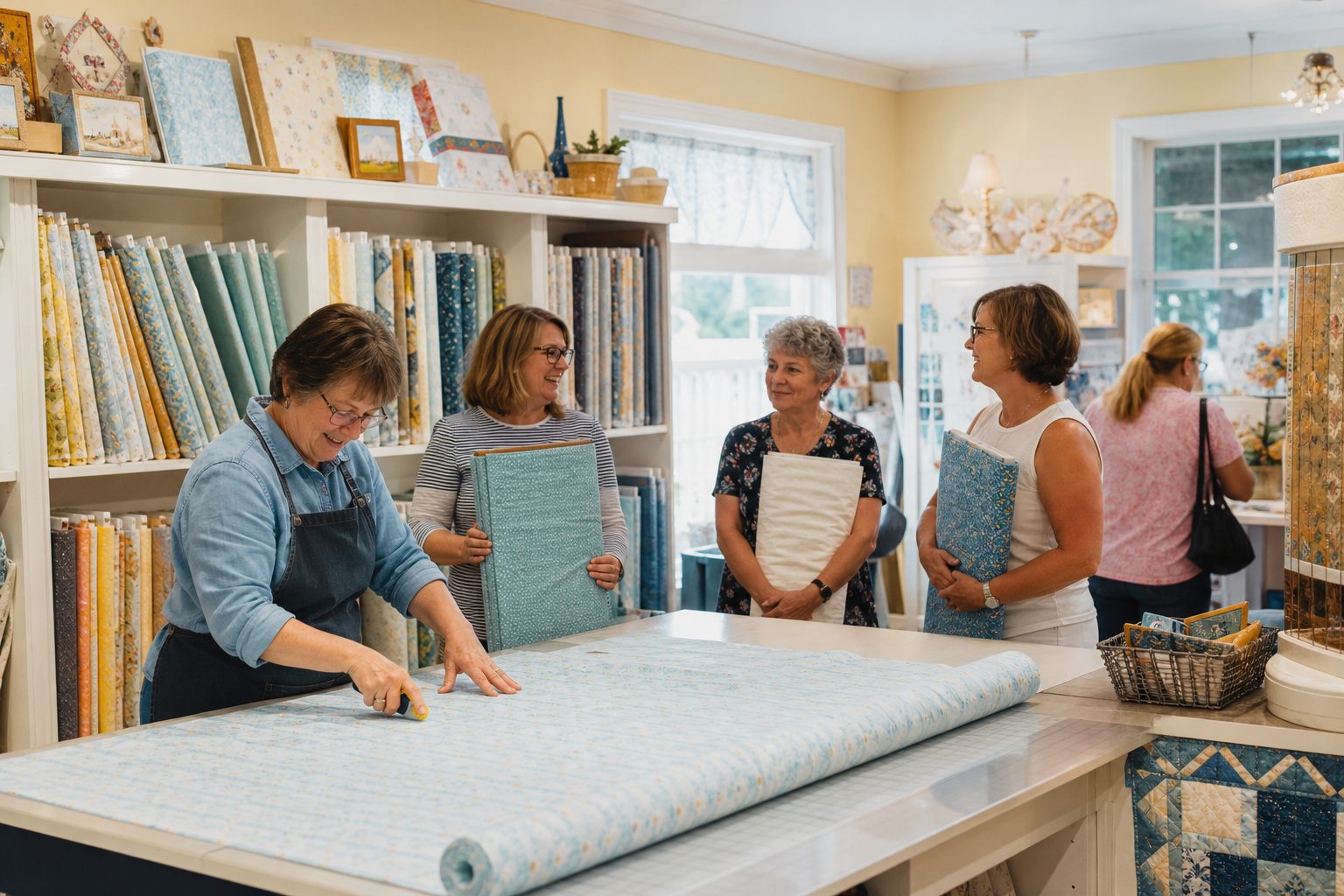
case study
How did one shop cut its dead bolt inventory in half over a single fiscal year?
A walk through of one independent shop's reset: how it classified aging bolts, staged markdowns by season, and changed reorder minimums so the problem did not come back.
The short answer is unglamorous. The shop stopped arguing about which bolts were slow and wrote a rule that decided it for them, then applied that rule on a calendar instead of on a mood. Everything after that was execution.
The shop in this account is a composite drawn from the way independent quilt retailers actually run this work, and the numbers below are worked examples built from stated assumptions, not measured results from a survey. What is real is the method: classify by weeks of supply, mark down in stages that line up with guild and retreat season, convert what will not sell flat into kits and bundles, and then change the reorder minimums that created the pile in the first place. Do only the markdown half and the pile rebuilds itself in eighteen months.
Cutting dead bolt inventory in half over a fiscal year is not a clearance event. It is four decisions repeated every month.
The starting picture: months on hand by department
Before any of it, the owner needed one number per department: months on hand. Take the cost value of what is sitting on the shelf, divide by the average monthly cost of goods sold for that department over the trailing twelve months. A department holding $18,000 at cost that moves $2,000 a month at cost is carrying nine months on hand.
Here is the kind of spread that shows up when a shop looks for the first time.
| Department | Cost on hand | Monthly COGS | Months on hand |
|---|---|---|---|
| Basics and blenders | $14,000 | $3,500 | 4.0 |
| Current collections | $21,000 | $4,200 | 5.0 |
| Batiks | $16,000 | $1,600 | 10.0 |
| Novelty and licensed | $9,000 | $600 | 15.0 |
| Flannel and wide backs | $12,000 | $1,500 | 8.0 |
Nothing in that table says batiks are bad. It says the batik wall is sized for a shop that sells more batiks than this one does. That is a buying problem wearing a merchandising costume, and it is fixable.
Keep reading: What happens to my shop when the big fabric collections shift to online only distribution?
Defining a dead bolt in weeks, not in feeling
The rule this shop adopted had three tests, and a bolt had to fail two of them to be flagged.
- Age on floor. More than 18 months since first receipt.
- Weeks of supply. Yards remaining divided by average yards cut per week over the last 26 weeks, above 52 weeks. A bolt with 9 yards left cutting 0.1 yards a week is carrying 90 weeks of supply.
- Recent motion. Zero cuts in the trailing 90 days.
Two failures out of three, and the bolt goes on the list. The two-of-three structure protects the bolt that is old but still cutting steadily, which is exactly what a beloved basic looks like, and it protects a brand new bolt that has not had time to prove anything.
Running that rule the first time produced 214 flagged bolts holding roughly 1,900 yards at an average landed cost near $5.60 a yard. That is about $10,600 of cost sitting in fabric that had told the shop, in writing, that it was not moving.
Staged markdown ladder timed against quilt guild season
The instinct is to slash to 50 percent and be done. The shop built a ladder instead and let each rung run long enough to be seen by a different set of customers, because guild meetings, retreats and class terms bring different people through the door in different months.
| Stage | Timing | Discount | Placement |
|---|---|---|---|
| 1 | Weeks 1 to 6 | 20 percent | Stays in department, flagged tag |
| 2 | Weeks 7 to 14 | 35 percent | Endcap near cutting counter |
| 3 | Weeks 15 to 22 | 50 percent | Clearance wall, sorted by color |
| 4 | Week 23 onward | Convert or donate | Off the wall entirely |
The timing mattered more than the percentages. Stage 3 was deliberately dropped into the weeks before the two big regional retreats, when quilters buy volume and are less picky about whether a print is current. Stage 1 was launched in the quiet stretch after the holidays, when a 20 percent tag reads as a treat rather than as a desperation signal.
One discipline held the whole ladder together: a bolt never moved backward. Once it was at 35, it was never restored to full price because the owner suddenly liked it again in a different light.
What the margin actually does at each rung
Take a bolt costing $5.60 a yard, retailing at $13.99. At full price the gross margin per yard is $8.39, about 60 percent. At 20 percent off, the customer pays $11.19 and the margin is $5.59, roughly 50 percent. At 35 percent off, $9.09 and $3.49. At 50 percent off, $7.00 and $1.40, which is 20 percent margin and still above cost.
Keep reading: What actually happens on the shop floor during a busy row by row or shop hop weekend?
Turning slow yardage into kits, bundles and charm packs
Roughly a third of the flagged yardage never needed a markdown at all. It needed a different unit of sale.
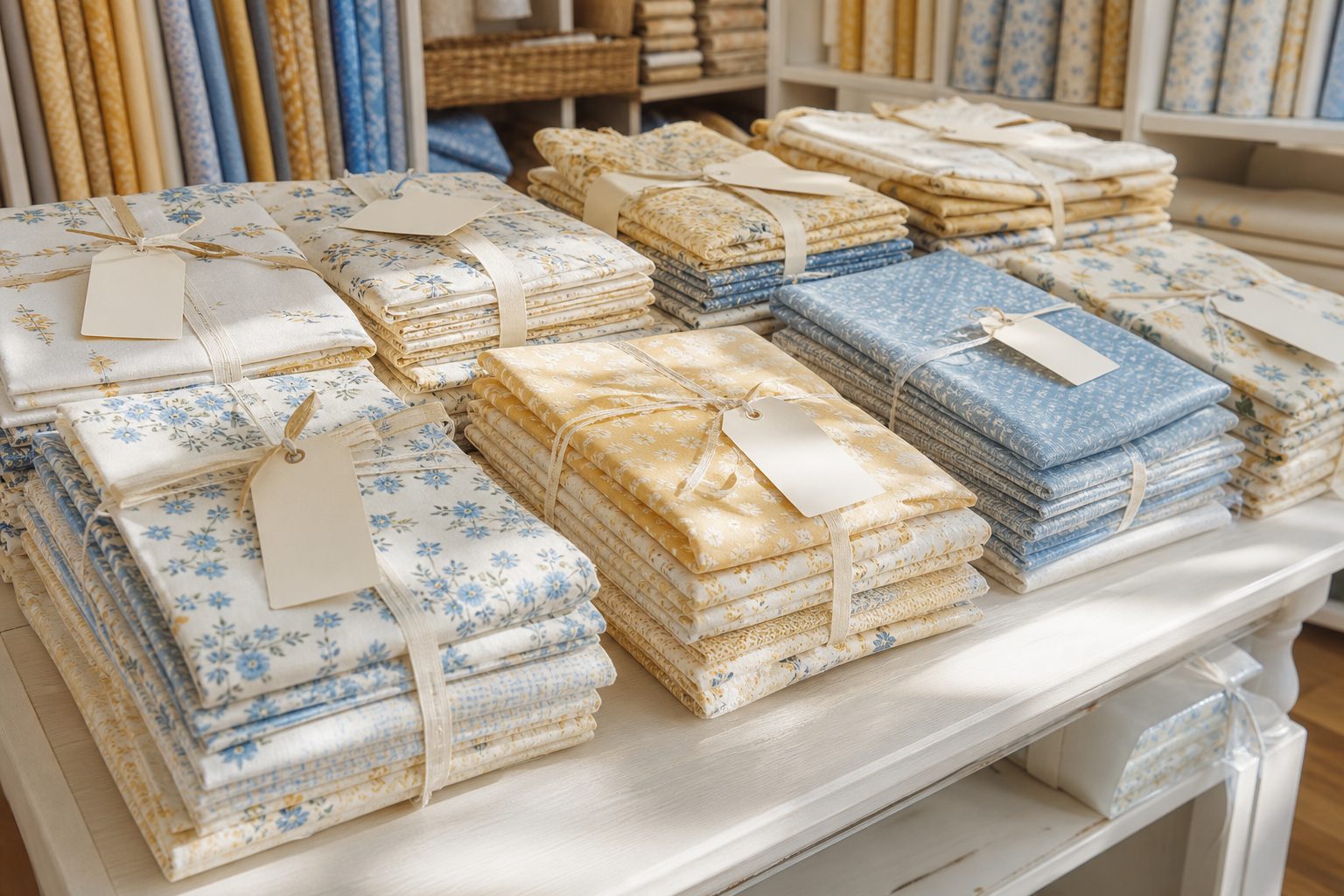
- Fat quarter bundles. Six coordinating quarters, tied, at a price that netted more per yard than a half-off cut.
- Charm and layer cake style precuts. Cut in house from bolts with 3 to 6 yards left, which is otherwise an awkward remainder.
- Pattern kits. A pattern the shop already stocked, plus the yardage it calls for, bagged with a printed cutting list.
A kit is where the arithmetic gets interesting. Suppose a lap quilt pattern calls for 3.25 yards of assorted prints plus 1.25 yards of background. At $5.60 landed, that is $25.20 of fabric cost. Add a $6.00 pattern at $3.00 cost and a bag at $0.40. Total cost $28.60. Sold as a kit at $69.00, the margin is $40.40, about 59 percent. The same yardage sold at 50 percent off the bolt would have brought $31.50 with $3.50 of margin.
The catch, and it is a real one, is labor. Cutting and bagging a kit takes a staff member roughly 20 to 25 minutes including the cutting list. At $18 an hour loaded, that is about $7 of labor per kit. The margin is still $33. The constraint is not profitability, it is how many hours the shop can spare in a week, which is why kitting works best as a slow, steady Tuesday morning task rather than a weekend push.
Rewriting reorder minimums after the clearout
This is the section that decides whether the year was a reset or just a sale.
Most quilt shops carry an unwritten rule that a bolt gets reordered when it drops below some yardage, often three or four yards, regardless of what it is. That rule is why the batik wall was ten months deep. It treats a bolt cutting four yards a week and a bolt cutting a quarter yard a month as the same object.
The replacement rule is a coverage target, not a yardage floor. Decide how many weeks of supply each department should carry, then let each bolt calculate its own trigger point.
- Reorder point equals average weekly yards cut, multiplied by lead time in weeks, plus a safety cushion.
- A basic white cutting 5 yards a week with a 3 week lead time and a 2 week cushion triggers at 25 yards.
- A novelty print cutting 0.2 yards a week under the same terms triggers at 1 yard, which in practice means it never reorders, and that is the correct answer.
See how QuiltCounter handles this for quilt shops and fabric retail
Cash freed and where it went next
Over the fiscal year, the flagged pool went from about $10,600 at cost to roughly $5,000. Some sold at stage 1 and 2, a larger share sold at stage 3, kits absorbed a meaningful chunk at better margin, and a small tail was donated to a guild charity sewing group at the end of stage 4, which cleared shelf space and generated a deduction the shop's accountant handled.
That released about $5,600 of tied up cost, plus roughly 12 linear feet of wall. The wall was worth more than the cash. It went to two things: a deeper basics section, because basics are the highest turn department in almost every quilt shop, and a proper wide back rack, which had been living folded on a table where nobody could see it.
What the shop would do differently the second time
Three things, all of them about pacing.
First, run the flag rule monthly from day one rather than annually. A list of 214 bolts is an intimidating project. A list of nine bolts is a Tuesday. The rule is the same either way, and the monthly version never lets a backlog form.
Second, start the kitting before the markdowns, not after. Once fabric has worn a 35 percent tag on the clearance wall, customers have already priced it in their heads, and a $69 kit built from it feels like a trick. Kits made from bolts that are quietly slow but still at full price read as a curated offer.
Third, set the reorder rules first. The clearout took eleven months of attention while the buying habits that caused it were still running in the background. Fixing the intake would have made the outflow smaller.
Where to start on Monday
Pick one department, the one you already suspect. Pull yards remaining, first receipt date, and cuts in the last 90 days for every bolt in it. Apply the two-of-three rule. Whatever number comes back, that is your real starting picture, and it will be more honest than your gut list.
The reason most shops never get past that first step is that the data is not in one place: yardage lives on a handwritten bolt tag, sales live in the register, and receipt dates live in a folder of packing slips. QuiltCounter tracks fabric at the bolt level in yards, so every cut updates the remaining yardage automatically and each bolt carries its own receipt date and cut history. That makes the flag rule a report you run rather than an afternoon you lose, and it makes reorder alerts fire on weeks of supply instead of a flat yardage floor. If you want the version of this year that does not have to be repeated, that is the piece to put in place first.