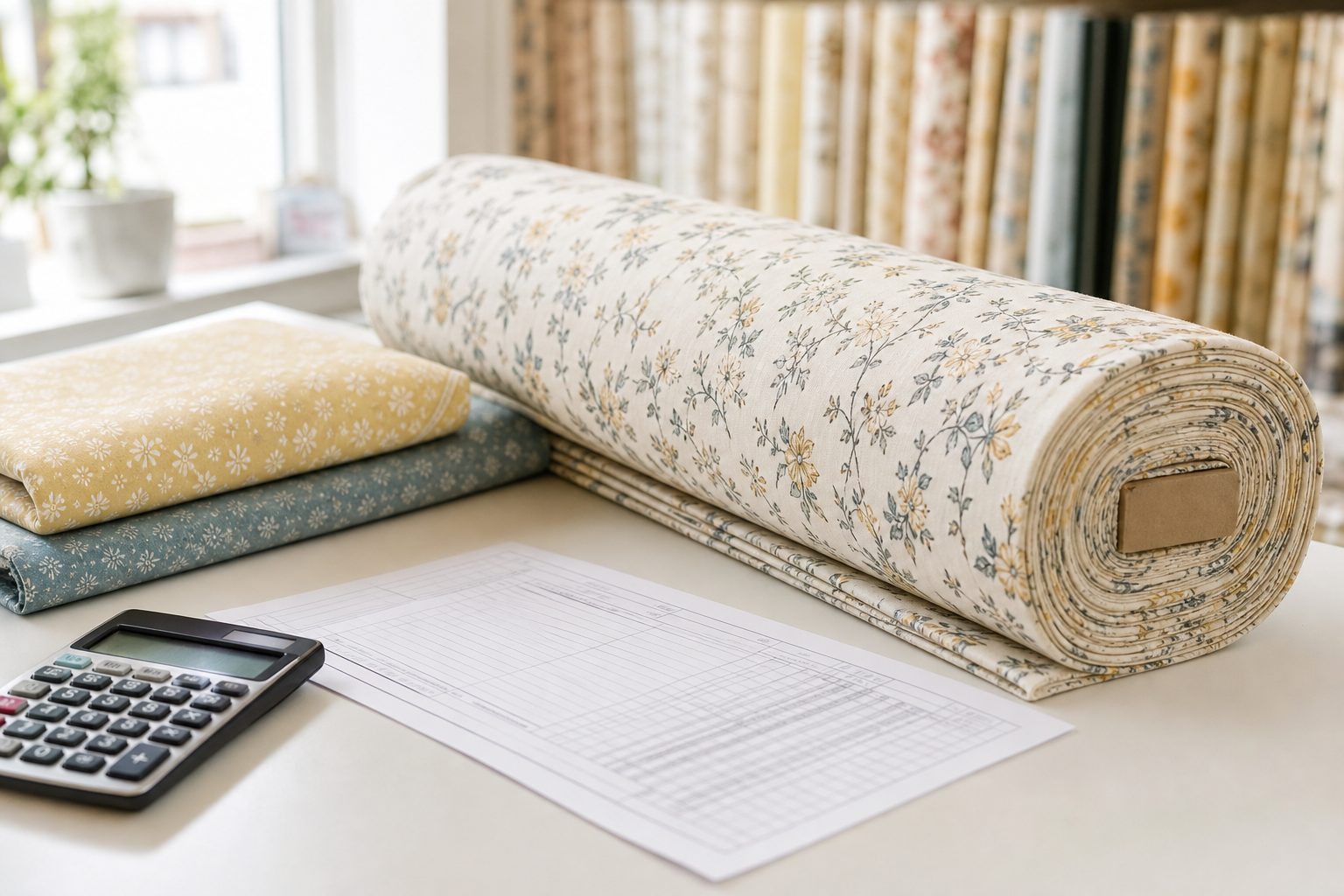
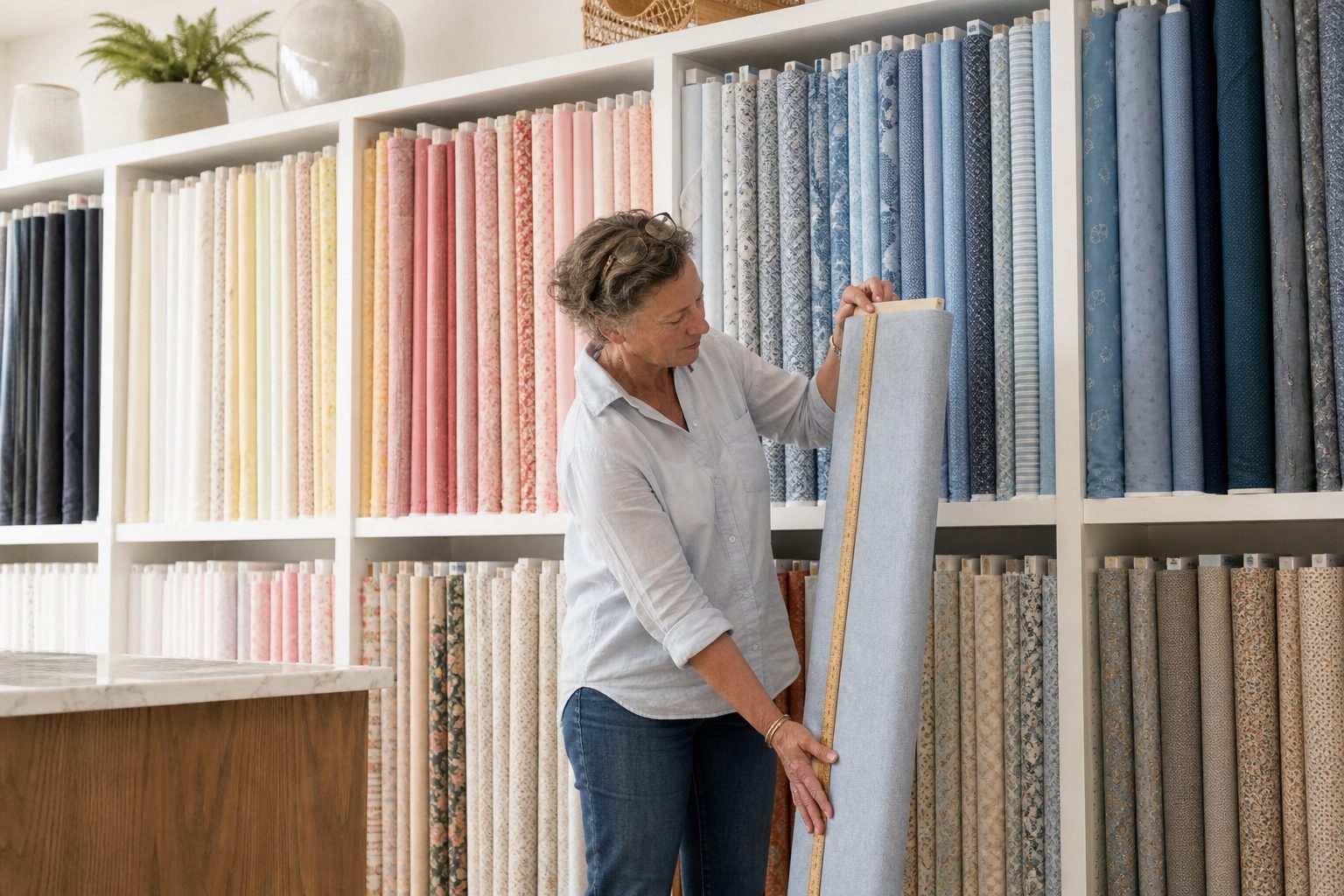
field report
What actually happens on the shop floor during a busy row by row or shop hop weekend?
A close look at how a multi shop hop weekend runs: staffing the cutting counter, prepping the exclusive fabric, passport handling and the restock work that lands on Monday.
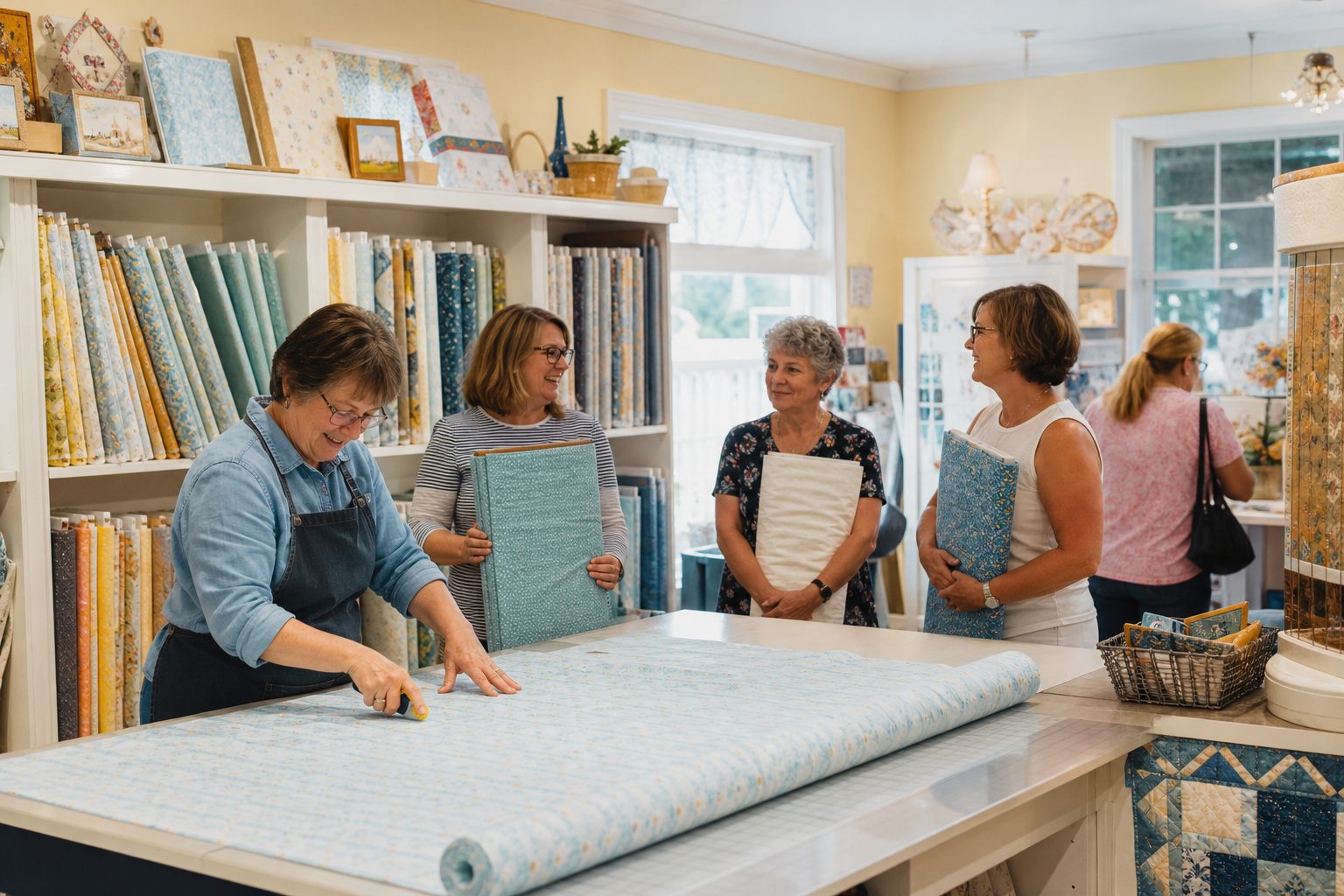
What happens is a compression. Three or four weeks of foot traffic arrives across two and a half days, most of it in a four hour band each morning, and almost all of it wanting the same three or four items. The floor does not fail because the shop is unpopular. It fails at the cutting counter, where the line forms and stops moving.
The second thing that happens is invisible until Monday. Yardage records drift badly under that volume, because staff cut fast, write bolt tags later or not at all, and ring up multi cut sales in a hurry. A shop can have an excellent hop and open Tuesday not knowing what is left on half its wall.
This is a walk through of the weekend as it actually runs, from the commitment months earlier to the reconciliation that lands after everyone has gone home.
How a regional hop is organized and what a shop commits to
A row by row or shop hop is typically coordinated by a group of shops in a region, sometimes through a state association, sometimes as an informal ring that reforms each year. Participating shops agree on the dates, a shared passport or punch card, and a set of rules that every shop has to honor.
The commitments usually look like this.
- Open specific hours on all hop days, often longer than your normal hours.
- Buy into a shared print run of the exclusive fabric, pattern or block.
- Stamp passports for anyone who walks in, purchase or not.
- Contribute to a grand prize pool, and hold your own in shop drawing.
- Pay a participation fee that covers the shared print advertising and passport printing.
The last one is worth pricing honestly. Between a participation fee, the exclusive fabric buy, extra staffing hours and a prize basket, a shop can be $2,500 to $4,000 in before the doors open. That is not a reason to skip it. It is a reason to know your break even before you sign.
Keep reading: How do I set my price per yard when my wholesale cost keeps moving on reorders?
Ordering the exclusive fabric and pattern months ahead
The exclusive is the axis the whole weekend turns on. Hoppers collect the fabric across all participating shops, and a shop that runs out on Saturday morning becomes the one everyone complains about in the car.
Quantity is the hard call, and it is made four to six months early. The workable method is bottom up.
Estimate hoppers first. If the ring has 12 shops and the coordinators printed 900 passports last year with roughly 600 completed, plan against 600 to 700 serious hoppers. Assume 70 percent buy the exclusive at your shop, so 420 to 490 cuts. Most buy a half yard or a fat quarter. Call it 0.6 yards average, which puts you near 250 to 300 yards.
Then hold a reserve. Ten to fifteen percent over the estimate is normal, because the alternative is a customer who drove ninety minutes and cannot complete her set.
At 280 yards and $5.50 landed, the exclusive fabric is roughly $1,540 of cash committed months before a dollar comes back. If it sells at $13.99 a yard on 0.6 yard cuts, each hopper spends about $8.39 and returns about $5.09 of margin. At 450 cuts that is roughly $2,290 of margin on the exclusive alone, which is most of the way to covering the weekend's fixed cost.
The pattern is where the margin lives
The exclusive pattern costs you $3 to $5 wholesale and sells for $10 to $12. It needs no cutting, it never runs short in a way that ruins a passport, and it pulls yardage behind it because the pattern calls for background and binding you already stock. Order it generously. Leftover patterns keep indefinitely. Leftover exclusive fabric becomes clearance in ninety days.
Staffing the cutting counter for peak hours
Model the counter, do not guess at it. A clean cut with measuring, straightening, cutting and folding takes 90 seconds to two minutes for a single cut, and a customer with five bolts is closer to seven minutes.
One cutter therefore handles somewhere near 9 to 10 customers an hour at three bolts each. If 200 people come through between 10am and 2pm and 70 percent buy fabric, that is 140 cutting transactions in four hours, or 35 an hour. Four cutters, and even then the line is real.
| Station | People | Job |
|---|---|---|
| Cutting counter | 3 to 4 | Cut only, no register, no questions answered at length |
| Register | 2 | Ring, bag, stamp passport, enter drawing |
| Floor | 1 to 2 | Answer questions, reload the exclusive, tidy the wall |
| Door | 1 | Greet, explain the layout, hand out the shop map |
Separating cutting from ringing is the single biggest throughput change available. A cutter who also takes payment loses half her cutting capacity to card terminals and small talk. Give the cutters a numbered ticket system, put the exclusive on its own dedicated table away from the main counter, and precut a substantial share of it into half yards and fat quarters before Friday.
Precutting is not cheating. It is the difference between a 20 second exclusive transaction and a two minute one, repeated 450 times.
Keep reading: What does my state actually require me to collect in sales tax on fabric and class fees?
Passport stamping, prize drawings and the traffic pattern
Passport handling belongs at the register, not at the door, because the register is where you already have the customer's attention and a pen. Stamp it as part of bagging, and it never becomes a separate queue.
The drawing entry is your only real data capture of the weekend. A slip with name, email and town, dropped in a basket, is how a hop turns into a mailing list. Ask permission plainly on the slip and honor it.
Traffic runs in a predictable shape. Thursday and Friday morning bring the serious hoppers who plan a route and move fast. Saturday brings groups, mixed intent and the longest lines. Sunday afternoon is quiet and full of people finishing a set. Staff Saturday heaviest, and put your most patient cutter on Saturday midday.
Keeping bolt yardage accurate at four times normal volume
Here is the part shops underestimate. In a normal week a bolt might get cut four times. Over a hop weekend a popular basic gets cut forty times. If yardage is tracked on a handwritten tag, forty hurried subtractions produce a number nobody trusts by Sunday.
Three habits keep it honest.
- Cut is recorded at the moment of the cut, not at the register. Every cut updates the bolt's remaining yardage right there.
- Low bolts get pulled, not stretched. Set a floor, say one yard, below which the bolt comes off the wall and becomes a remnant. A bolt with 0.4 yards left is a disappointment waiting for a customer who wanted a yard.
- A midday reload sweep. One person walks the wall at 1pm, notes anything below the floor, refills the exclusive table and flags what needs a backroom bolt.
The exclusive needs its own count. Track precut units separately from bolt yardage, and check the remaining count at every shift change, because that is the number that determines whether you can promise a Sunday customer anything.
See how QuiltCounter handles this for quilt shops and fabric retail
Restock, reconciliation and returns on Monday
Monday is a real workday and should be scheduled as one, not treated as recovery.
The sequence that works.
- Reconcile the register against cash and card batches while the weekend is fresh.
- Physically count the exclusive fabric and pattern remaining, and compare to units sold.
- Walk the wall for gaps. Anything cut through completely goes on the reorder list today, because you are competing with eleven other shops reordering the same basics.
- Spot check yardage on the twenty bolts that moved most. If recorded yardage and actual differ by more than half a yard, you have a process problem, not a counting problem.
- Enter drawing slips into your mailing list, then run the drawing and notify the winner.
- Fold, straighten and re bolt everything the weekend disturbed.
Reorder speed matters more than usual. A hop drains white background fabric, neutral blenders and coordinating solids across an entire region in the same 60 hours. The shop that submits its reorder Monday morning gets stock; the shop that gets to it Thursday waits.
Deciding whether to join again next year
Do the math with real lines, not a feeling about the energy in the room.
Add your direct costs: participation fee, exclusive fabric and pattern at cost, extra payroll hours, prize basket, printing and signage. Then take gross margin on hop weekend sales, less the same weekend last year if it was not a hop, which is your incremental margin.
A rough sketch. Costs of $3,200. Weekend sales of $16,000 at 55 percent margin gives $8,800. A normal weekend might have produced $2,600 in sales and $1,430 in margin. Incremental margin is about $7,370 against $3,200, so the weekend cleared roughly $4,100.
Then look at the part that is not on that line. How many drawing slips were from towns you never see? How many hoppers came back in the following eight weeks? How much clearance did the leftover exclusive become? Those three answers decide the next year more than the weekend total does.
The thing to fix before the next one
Almost every shop that has run a hop names the same weak point: knowing what was left, on which bolt, while the line was still out the door.
QuiltCounter records fabric by the bolt in yards, so every cut during the weekend reduces the right bolt in real time and the wall report on Monday is a number rather than an estimate. Reorder alerts fire on the basics the hop drained while the reorder still matters, kit and bundle assembly tracks the precut exclusive as its own item, and class registration keeps the sign ups you collect over the weekend from turning into a stack of paper. Set it up before the passports print, and the weekend leaves you with a customer list and an accurate wall instead of a pile of guesswork.