trends and outlook
What happens to my shop when the big fabric collections shift to online only distribution?
Minimum order quantities, designer direct releases and precut formats are reshaping what an independent shop can stock. What the shift looks like from the buying side and how to plan around it.
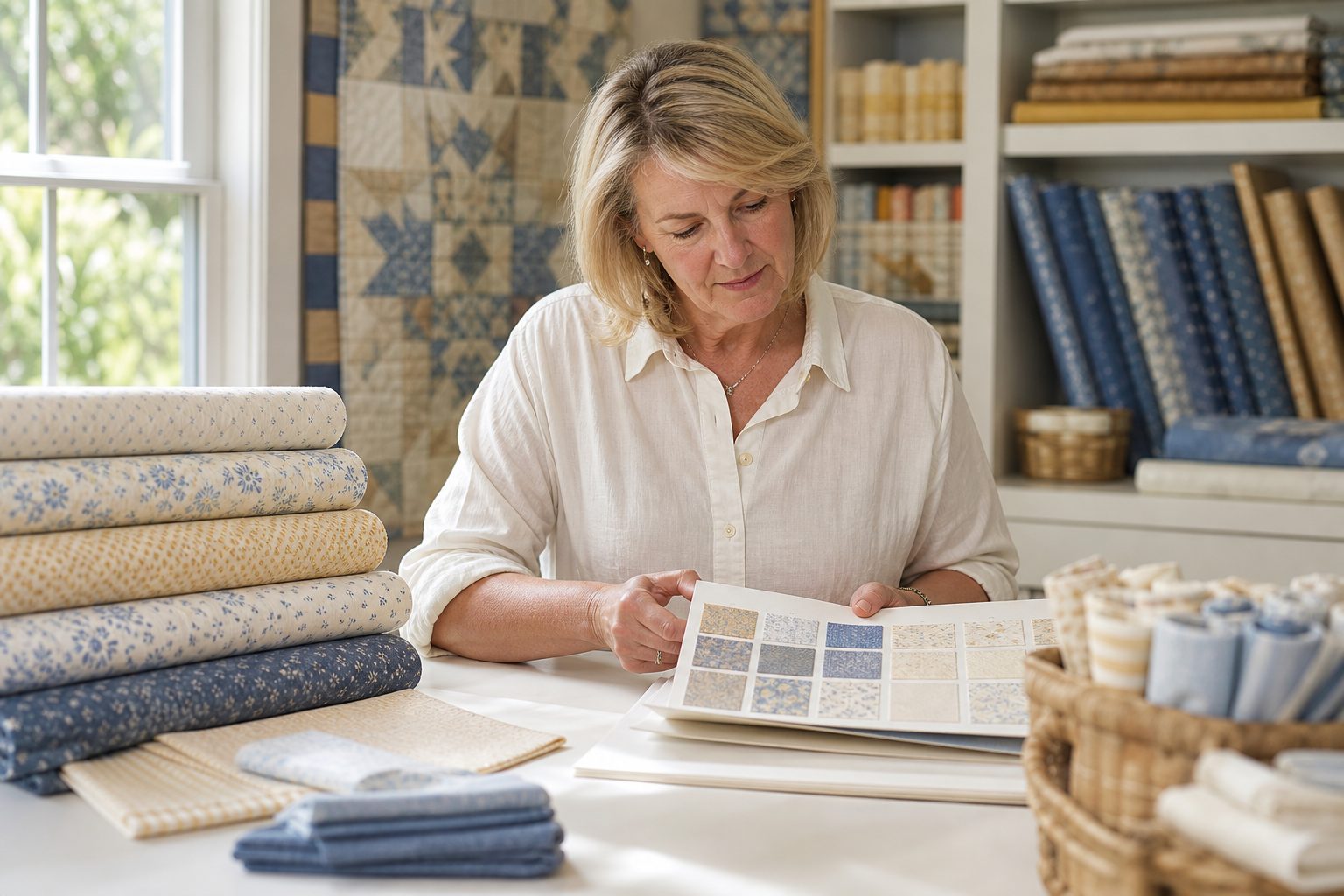
Nothing gets taken away from you overnight. What changes is the shape of the offer: longer preorder windows, higher minimums on the groups you most want, more of the assortment arriving as precut formats, and a growing share of designer work sold direct to the quilter before it ever reaches a wholesale line sheet.
The practical effect on a small shop is that buying decisions move further from the sale. You commit in February to fabric that lands in September and sells through the following spring. That is a cash flow question and a forecasting question at the same time, and it rewards shops that know their own history in numbers rather than in impressions.
None of this makes an independent shop obsolete. It does make casual buying expensive. Here is what the shift looks like from the buying side, and what a shop can actually do about each piece of it.
How collection release cycles and preorder windows work now
A quilting cotton collection typically moves through a fixed sequence. The designer and mill finalize the group. Strike offs and swatch cards go to sales reps. Reps present at market or on appointment. Shops preorder against a delivery month that is usually four to eight months out. The mill prints to the order book, and delivery follows.
Two features of that sequence matter to you more than the rest.
The first is that the order book largely determines the print run. If a group is undersold at preorder, the run is small and reorders may simply not exist. The phrase "no reorders on this collection" is not a sales tactic in most cases, it is a description of how the mill scheduled the press.
The second is that your commitment date and your sell date are separated by two seasons. You are forecasting demand for a print you have seen only on a swatch card, for a customer base whose mood you cannot check in advance.
What that does to your cash
Preorders usually bill on shipment, not on order, which sounds fine until three collections you forgot about all deliver in the same three weeks. A shop that preorders 6 groups at an average of $900 landed has $5,400 committed. Delivered evenly across six months that is manageable. Delivered in two clumps it is a line of credit conversation.
The fix is a delivery calendar, not a discipline lecture. Every preorder gets logged with its expected delivery month the day it is placed, and you look at the monthly totals before you sign the next one.
Keep reading: What actually happens on the shop floor during a busy row by row or shop hop weekend?
Minimum order quantities and the small shop buying problem
Minimums show up in three forms, and it helps to name them separately because they are negotiated differently.
- Opening order minimum. A dollar figure to become an account at all, often several hundred to a couple thousand dollars.
- Reorder minimum. A smaller dollar or yardage floor per shipment, which is what makes topping up a single popular basic annoying.
- Per SKU minimum. The one that bites. Frequently a full bolt of a stated length, and increasingly a requirement to take a whole group rather than picking six prints out of twenty four.
Whole group buying is the real change. A twenty four print collection at a 15 yard bolt each, landed near $5.75 a yard, is about $2,070 of commitment for one group. A shop that used to buy the eight prints it believed in now either takes all twenty four or passes.
Do the arithmetic before you agree, because the shape of the group determines the answer. Take a rough split of a typical collection: four prints that will sell fast, twelve that will sell at a normal pace, and eight that will linger. If the eight lingerers each end with 7 yards left after eighteen months, that is 56 yards, roughly $322 at cost, stranded from a $2,070 buy. About 16 percent of the commitment.
Whether that is acceptable depends on what the four fast prints do. If they cut through 15 yards each at $13.99 retail, that is roughly $840 of gross margin on those four alone. The group can work. It just is not free, and pretending the eight lingerers do not exist is how the clearance wall gets built.
Precuts, bundles and the shrinking role of the full bolt
Precut formats keep expanding: 5 inch squares, 10 inch squares, 2.5 inch strip rolls, fat quarter and fat eighth bundles. From a mill's view they are efficient, they present a whole collection in one SKU, and they ship small. From a shop's view they are a mixed blessing.
The good part is real. A precut bundle puts an entire coordinated group on the shelf for well under the cost of the bolts, and it sells to the quilter who wants variety without decisions.
The hard part is that precuts do not replace yardage, they create demand for it. Nearly every pattern written for a strip roll also calls for background, binding and backing, which the customer buys by the yard. A shop that leans hard into precuts and thins its basics wall ends up selling the appetizer and losing the meal.
The practical stance most working shops land on: buy precuts for breadth and buy bolts for depth. Precuts carry the collections you cannot justify at bolt level. Bolts carry the solids, the blenders, the wide backs and the batting adjacent goods that every project needs regardless of which collection is current.
Keep reading: How do I set my price per yard when my wholesale cost keeps moving on reorders?
Designer direct sales and licensed exclusives
More designers now sell finished goods, patterns and sometimes fabric directly through their own storefronts and subscription clubs. Some run their releases to their own mailing list before or alongside wholesale delivery.
That changes the timing of demand in your shop. A customer may arrive already knowing a collection exists, already having seen the sample quilt, and already deciding whether she wants the version from the designer or the version she can touch today.
Licensed exclusives cut the other way and are worth pursuing. Shop hop exclusives, guild colorways, and shop specific patterns give you something the designer's own site does not have. The lever is not price, it is availability and locality.
Buying groups, market appointments and shared orders
The structural answer to rising minimums is aggregation. Three routes are commonly used.
| Route | What it solves | What it costs you |
|---|---|---|
| Formal buying group | Opening and reorder minimums, sometimes better terms | Dues, meeting time, some assortment conformity |
| Informal shared order with nearby shops | Per SKU and whole group minimums | Coordination, splitting freight, one shop fronting cash |
| Market appointments booked early | Access, allocation on tight groups, rep attention | Travel and closed shop days |
A shared group buy is the most useful and the least formal. Three shops splitting a twenty four print collection eight ways each gets a genuine assortment for roughly $690 apiece instead of $2,070. The failure mode is always the same: nobody agreed in writing who takes which prints and who eats the freight. Settle both before the order goes in, and pick the prints in a rotating draft so the fast sellers get distributed rather than claimed.
See how QuiltCounter handles this for quilt shops and fabric retail
What a shop can offer that a website cannot
Be specific here, because vague answers about community do not survive a slow February.
- Cutting to the customer's project. A website sells in half yard increments. You cut the 1.75 yards the pattern actually needs and cut it straight.
- Color matching in hand. Bringing a finished top in and holding six backings against it is not reproducible on a screen.
- Substitution knowledge. Knowing which current blender stands in for a discontinued print from four years ago is inventory knowledge plus memory.
- Classes and machine support. The reason a beginner finishes a first quilt at all.
- Kits built from what is on your shelf. Curated, local, and available today.
All five depend on knowing what you actually have, in yards, right now. A confident answer at the counter is inventory accuracy wearing a friendly face.
Planning open to buy against a longer lead time
Open to buy is just a monthly budget for purchases, and longer lead times make it more important, not less. The calculation is plain.
Planned open to buy for a month equals planned end of month inventory, plus planned sales at cost for the month, minus opening inventory at cost, minus purchases already committed for delivery that month.
A worked example. You plan to end March holding $70,000 at cost. March sales at cost are planned at $9,000. You open March holding $73,000. Preorders already scheduled to deliver in March total $4,500. Open to buy equals 70,000 plus 9,000 minus 73,000 minus 4,500, which is $1,500. That is the whole discretionary budget for the month, and it exists because you committed most of it at market last fall.
Two habits make this workable. Log every preorder against its delivery month at the moment you place it, so the committed line is never a surprise. And reserve a slice, perhaps 20 to 25 percent of annual planned purchases, as unallocated, so you can chase a basic that is suddenly cutting or restock a class fabric mid term.
Where this leaves you
The shift rewards shops that buy on evidence. Which prints from last spring's group actually cut through, how fast, and what is still sitting. Which departments carry more weeks of supply than they earn. Which classes pull yardage with them.
QuiltCounter is built for that evidence: bolt level yardage so every cut is recorded against the bolt it came from, receipt dates and cut history per bolt so you can judge a collection by what it did rather than by what you remember, reorder alerts tuned to how fast each bolt actually moves, and class registration linked to the fabric those classes consume. When your next market appointment comes around, the difference between guessing and knowing is a report you can pull in a minute.